
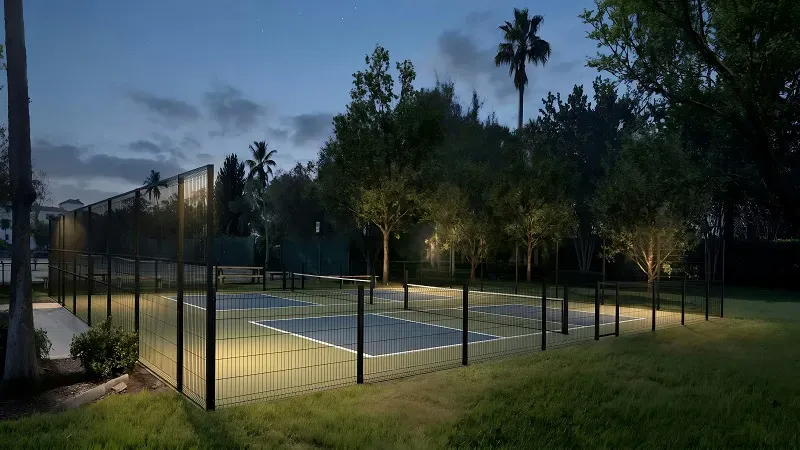
Most pickleball courts start as an idea in a group chat. Someone says the neighborhood should have one, a few people nod, and then the questions begin. Where does it go? Who pays? What will the people next door say? A court built for a whole community is a bigger project than a backyard one, and the early choices are the ones you will live with longest.
Who’s actually going to play?
Figure this out before you talk to anyone selling anything. A homeowners association full of retirees will want different things than a youth group or a church. How many people show up on a Saturday morning? Will one court be enough, or will players stand around waiting their turn? Ask about kids and guests too, since shared courts rarely stay members-only for long. A quick poll of members can head off an expensive “we should have built two.”
Space, sun, and surface
A regulation court is 20 feet by 44 feet, but that is just the lines. You want a good bit of room around it so players can chase a ball without running into a fence or a bench. Pick ground that is flat and drains well, and check where the sun sits late in the day. Glare is an underrated complaint.
Surfaces come in three main families. Concrete lasts and needs little care, though it is tough on knees. Asphalt gives a little more but needs upkeep. Modular and turf-based sport surfaces are softer and shed water, which helps if your regulars are older. Ask each installer how their surface copes with a hot summer and a wet spring, and what a repair costs when something does go wrong.
Picking the people who build it
The base and layout matter more than the name on the surface, so ask about experience early. Turft, a Nashville installer, lays out how it handles community pickleball court installation, including surfaces like VersaCourt, plus lighting and fencing. Whoever you talk to, visit a finished court if you can, get the scope in writing, and read the warranty before you sign.
The details people forget
Nets should be 36 inches high at the sidelines and 34 at the center, so check that whatever you buy matches. Permanent nets hold up better in shared spaces, while portable ones make sense if the court doubles as something else. If anyone will play after dark, LED lights are efficient, and where you aim them matters as much as how bright they are. Fencing around 10 feet high keeps balls from ending up in the street.
Then there is noise. Pickleball is loud in a way tennis is not, and the pop of the ball carries a long way. Check local rules and your association’s covenants, and talk to the nearest neighbors before the concrete is poured, not after. Quiet hours and a sensible location go a long way. A simple sign-up system for the court helps too, so the same few players do not end up owning it.
Money and upkeep
Get itemized quotes from more than one company, and make sure they are actually comparable. Grading, base prep, and line painting are the usual things left off a cheaper bid. Set aside something for upkeep as well, because a court that is busy every day wears faster than one in a private yard.
Visit a few courts, ask the people playing what they would change, and take your time. A shared court is only worth building if people actually use it.