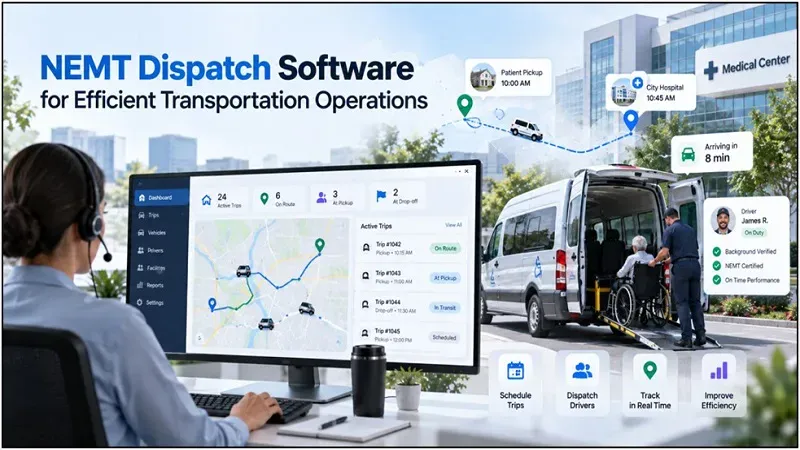
Ask any NEMT operator what challenges they often face. Most of them will mention bottlenecks in streamlining the operations. A driver stuck in traffic with no backup plan. A hospital coordinator calling because a patient never showed up. A spreadsheet that three people edited at once, and now nobody trusts the numbers.
None of that is really about transportation. It is about the system, or lack of one, holding the whole operation together.
NEMT dispatch software is supposed to fix exactly this. But not every platform does it well. The wrong choice can leave you paying for features you never use while missing the ones you actually need. Providers who research this decision carefully tend to see the difference within the first ninety days. Whereas those who sign with the first vendor that calls them back often spend that same stretch fixing avoidable problems.
This guide covers what to actually look for, in the order it tends to matter.
Start With Your Operations
Vendors love showing off feature lists. Most of those features would be irrelevant to your daily work.
A better start for you would be to write down how your business actually runs.
- How many vehicles are on the road on a typical Tuesday?
- Where do your trip requests come from, mostly hospitals, or a mix of facilities and individual patients booking directly?
- Do you run wheelchair vans and stretcher vehicles?
A provider running six vehicles out of a single county has different needs than one coordinating forty vehicles across three counties with five hospital contracts.
Once you know your requirements, you can tell within the first fifteen minutes of a demo whether a platform was built for you or built for someone else entirely.
Pin Down Where Things Actually Break
Every operator has a weak point. Some lose money to no-shows because nobody confirms trips the day before, while others watch drivers sit idle because dispatch is still done by radio and guesswork. Write yours down honestly, since the fix depends entirely on what it is.
If double-booked trips are your recurring headache, automated dispatch logic needs to be non-negotiable in your search. If billing disputes with hospital partners eat up your Fridays, prioritize invoicing and payment tools over anything else on the list.
Get A Straight Answer On Pricing
NEMT software pricing is rarely as simple as it looks on a website. Per-vehicle fees, per-trip fees, setup costs, and support tiers all stack differently depending on the vendor. Ask for a number tied specifically to your fleet size, not a generic quote pulled from their largest client.
A NEMT transportation software provider that cannot explain its own pricing structure in plain terms is worth a second look before you sign anything.
The Dispatch Features That Actually Move The Needle

Some features matter every single day. Others sound impressive in a sales call and then sit unused six months in. Here is where to put your attention.
- Automated dispatch with a manual override: The system should assign the nearest available driver on its own, but your dispatcher needs the ability to step in when a situation calls for judgment a computer cannot make.
- Live trip tracking: Everyone involved, dispatcher, provider, patient, should be able to see where a vehicle is without picking up a phone.
- A driver app that does not require training: If your drivers need a manual to accept a trip or update its status, the interface has already failed.
- Digital proof of pickup: A signature captured at the moment of pickup saves you during a billing dispute six weeks later, when memories have faded, and nobody can agree on what happened.
If a platform is missing even one of these, that gap becomes a daily annoyance, not a minor inconvenience you can work around.
Fleet Tracking That Reflects Reality
Your NEMT vehicle scheduling software needs to know the difference between a van that is available and one sitting in the shop with a blown transmission. This sounds obvious until you have watched a dispatcher assign a trip to a vehicle that will not be back on the road until Thursday. Good fleet tracking closes that gap before it becomes a missed pickup and an angry phone call.
Why Route Planning Matters More Here Than In Rideshare
A standard rideshare trip is point A to point B. NEMT trips often involve multiple stops, strict appointment windows, and passengers who need extra time to board. The routing engine has to account for all of that, not just distance and traffic.
A dialysis patient with a 7 am appointment cannot absorb a fifteen-minute detour because the software optimized for the shortest path instead of the right one.
What A Good Admin Dashboard Actually Looks Like
Your dispatch team will spend most of their working hours staring at this screen, so its design is not a cosmetic detail. It is an operational one.
Managing Trips And Clients Without The Chaos
Dispatchers need to see, edit, and track every active trip from one place, without switching between three tabs to find what they need. They also need client records that remember recurring appointment patterns, so a dialysis patient’s Tuesday and Thursday rides do not have to be rebuilt from scratch every single week.
Here is a good test during any demo. Ask the vendor to show you how a dispatcher handles a same-day cancellation, start to finish, since if it takes more than four or five clicks, that friction is going to repeat itself hundreds of times a month.
Billing That Does Not Fall Apart At Month End
NEMT management software should let you configure pricing by vehicle category, by distance, and by time of day, since a stretcher run at 2 am should not be priced the same as a sedan trip at noon. It should also generate invoices automatically and let clients pay online instead of mailing a check. Manual invoicing is one of the most common reasons NEMT providers fall behind on cash flow, and it is almost entirely preventable with the right tools.
Reports You Will Actually Read
Data is only useful if someone can look at it without exporting three spreadsheets. Look for dashboards that surface trip volume, driver performance, and on-time percentage in a format your team can glance at during a Monday morning meeting. These numbers tend to catch problems before a hospital partner brings them up in a review call, which is a much better position to be in.
The Provider And Patient Side Deserves Equal Attention
Plenty of buyers spend all their evaluation time on the dispatcher and driver experience, then treat the hospital-facing side as an afterthought. That is a mistake, because your healthcare partners are often the reason your business exists at all.
A dedicated provider dashboard lets hospital staff book rides, track patients in real time, and settle invoices without picking up the phone, which alone can cut your team’s daily call volume noticeably.
Patients matter here too, and not every patient has a smartphone. SMS alerts let them get pickup notifications and arrival updates without needing an app, while a short feedback prompt after each trip gives you an early signal if a particular driver or vehicle needs attention before it becomes a pattern.
Here is a question worth sitting with. Would a hospital discharge coordinator recommend your service to a colleague, based purely on how easy it was to book a ride? If you are not sure, the software behind that experience is worth a second look.
Compliance Is Not Optional
Every trip your business runs involves protected health information, which makes compliance a baseline requirement, not a premium feature some vendors charge extra for. Any platform on your shortlist should handle HIPAA compliant data across booking, tracking, and billing, without exception. Patient privacy needs to hold up before the trip, during the trip, and long after it, including how records get stored and who can access them later.
Ask vendors directly how they handle encryption, access controls, and audit trails. If the answer is vague or rehearsed, treat that as a real warning sign, not a minor gap you can overlook.
Questions Worth Asking Every Vendor
Keep this list handy during demos so your comparisons stay consistent across vendors.
- Can drivers, dispatchers, and providers each get a branded, separate interface?
- What third-party integrations are actually available, not just theoretically possible?
- How does the system resolve scheduling conflicts when two trips overlap?
- What does onboarding look like in week one, and who handles support after that?
- Can pricing rules differ by vehicle category and by individual client contract?
Vendors who answer with specifics, a real example, a screen they can show you, tend to be the ones worth pursuing. Vague answers usually mean the feature does not fully exist yet.
What To Check During A Vendor Demo

Match The Software To Where Your Business Actually Is
Smaller fleets should prioritize ease of use and fast onboarding. Your dispatch team is likely one or two people wearing several hats. A steep learning curve costs more than a missing feature ever will.
Larger fleets need automation depth instead. Manual dispatch cannot keep pace past a certain trip volume. Growing providers should ask about scalability early. Switching platforms mid-growth is expensive and disruptive, and it tends to happen at the worst possible time.
Matching Fleet Size To Priorities
Conclusion
Choosing dispatch software is not just a technology decision. It touches every driver, dispatcher, healthcare partner, and patient your business serves. The right NEMT dispatch software platform cuts down on missed pickups, speeds up billing, and gives everyone involved visibility into what is actually happening, in real time rather than after the fact.
The features in this guide, from dispatch automation to HIPAA compliant tracking, are the foundation of a system that holds up once daily volume gets real. Mobisoft Infotech builds a cloud-based NEMT platform around exactly this set of needs, with branded interfaces for admins, drivers, and providers built to scale as your fleet grows.
If your current process is holding your business back, a dedicated NEMT dispatch software solution is worth a close look before your next contract renewal comes around