
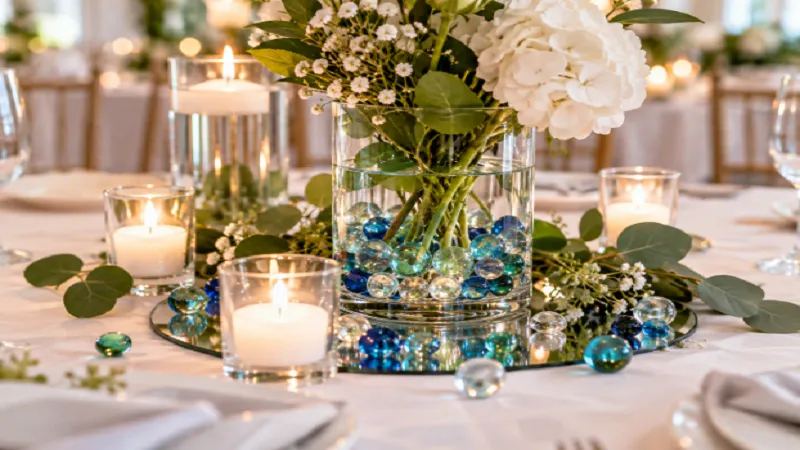
Event tables often carry much of a celebration’s visual identity. Guests see the linens, flowers, menus, and place settings both up close and from across the room. One small decorative layer can help those pieces feel connected. Glass marbles bring colour, weight, and reflected light to a tablescape without taking up much space. For weddings, dinners, fundraisers, and launches, they help make the setting feel finished.
Why small glass details matter at an event
A good centrepiece needs to work at more than one distance. From the end of a banquet table, guests should see rhythm; from their seat, they should notice texture rather than unrelated objects. Glass marbles catch daylight, candlelight, or venue lighting around flowers, branches, or a simple vessel. Because they sit low, they add finish without blocking conversation.
They are also useful when an event needs one repeated design cue. The same colour can appear in a bowl at the welcome table, around a floral arrangement, or in a shallow tray beside the bar. Repetition makes a large venue feel intentional, while a restrained palette keeps the decoration from becoming busy. Guests may not identify the detail immediately, but they will feel its effect.
Match the scale of the table and venue
Start with the surface rather than the decorative object. A narrow cocktail table may need only a small group in a low bowl or clear cylinder. A long reception table can take repeated arrangements at measured intervals, while a broad communal table can support a fuller vessel alongside flowers and menus. The goal is rhythm, not volume.
Guest comfort should guide placement. Keep the middle of a dining table open enough for conversation, and leave room for plates, glasses, and serving pieces. On a welcome or dessert table, move decoration toward the back or sides so it frames the service area. Small pieces can also fill an awkward gap on a registration table or low lounge table.
Venue scale matters too. A detail that reads beautifully in a private dining room may disappear in a large hall. Repeat the same shape or colour across several areas instead of relying on one concentrated arrangement. This gives the eye a path through the room and keeps the event cohesive.
Use light, colour, and transparency with intention
Surrounding light changes how the decoration feels. Clear pieces keep a daytime table airy and let linen or flowers provide the strongest colour. Coloured pieces create a stronger cue and can echo stationery, florals, or a brand palette. In an evening setting, reflected light gives a simple arrangement more dimension without adding another tall element.
Choose a colour that supports the event rather than competing with it. Soft neutrals suit romantic weddings and garden dinners, while deeper tones work for autumn celebrations or dramatic corporate settings. If the design already contains several colours, a clear or single-colour accent gives the eye somewhere to rest. Keep decorative pieces away from direct heat and follow venue guidance when candles or electrical lighting are nearby.
A practical starting point for event styling
If you are planning several tables, compare sizes and finishes before committing to a final arrangement. A useful starting point is a collection of glass marbles, so the event team can see how colour and scale work together. Laying out samples beside the linens, menus, and florals makes it easier to choose one repeatable detail and estimate how much is needed for the full room.
A short mock-up can answer practical questions early. Photograph the table from a guest’s eye level, check the arrangement under venue lighting, and make sure pieces stay stable when the table is bumped. For an outdoor event, test the setup with the expected breeze and keep loose elements away from edges. These checks reduce last-minute changes during installation.
Plan the end of the event too. Use vessels that can be counted quickly, keep spare pieces together, and decide whether the decoration will move to another area later in the day. A design that is easy to install, reset, and pack away helps when one room is turned over for a second gathering.
Let one detail travel through the celebration
A small material can do more than decorate the main table. Use the same colour at the entrance, on a gift table, around a cake display, or beside a lounge area. The pieces need not be arranged identically; repeating the palette or texture is enough to create a visual thread. This works well for weddings that move from ceremony to reception and for corporate events with several guest zones.
The detail can also change with the occasion. A daytime arrangement may use clear vessels and natural materials, while the evening version adds deeper colour or contrast. Keeping the underlying element consistent lets the event evolve without a complete change of decor between sessions.
A polished look without visual clutter
Successful event styling is rarely about adding something to every surface. It is about choosing details that make the room easier to read and more pleasant to spend time in. Glass marbles add colour, catch light, support a repeated theme, and help an ordinary table feel considered. With a clear plan for scale and placement, they become a small detail with a lasting effect.