
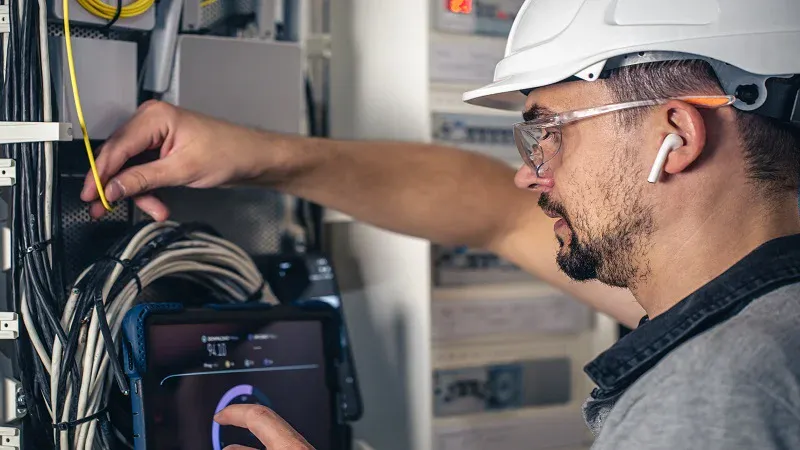
When the enterprise network goes down, the clock starts ticking on your budget. Business operations halt, employees sit idle, and revenue takes an immediate hit. According to Gartner, the average cost of network downtime is $5,600 per minute. For large organizations, that translates to well over $300,000 every single hour.
While IT teams instinctively check server configurations, software updates, and firewall rules during an outage, the foundation of the network frequently holds the actual blame. This foundation is your physical layer. In simple terms, the physical layer consists of the structured cabling that connects every device, server, and switch in your building. It is the absolute bedrock of enterprise network uptime.
If this physical foundation is weak, no amount of advanced routing or expensive hardware will save your connectivity. When haphazard wires and substandard installations compromise your physical layer, the resulting downtime can cost thousands of dollars per minute. To protect your infrastructure and ensure future scalability, it is critical to partner with experienced structured cabling contractors in Dallas who adhere to strict BICSI and RCDD standards.
Key Takeaways
- Network downtime carries a massive financial penalty, and a significant portion of these costly failures originate directly from poorly planned physical layer cabling.
- Separating your network architecture into distinct backbone (core) and horizontal cabling segments minimizes troubleshooting time and limits the blast radius of outages.
- True infrastructure future-proofing demands standardized designs that can easily support new bandwidth requirements without triggering expensive “rip and replace” retrofits.
- Vetting local Dallas contractors means demanding specific credentials, including BICSI certifications and RCDD expertise, to guarantee strict compliance with industry standards.
Why Enterprise Networks Fail at the Physical Layer
When users complain about a sluggish connection or a dropped VoIP call, software is usually the first suspect. Network administrators often spend hours hunting for misconfigured VLANs, routing loops, or faulty switch ports. Yet, the physical layer is frequently the actual point of failure. The wires running above your ceiling tiles and under your raised floors dictate the reliability of everything else in the IT stack.
A primary driver of this downtime is the lack of standardized infrastructure. Over the years, many IT closets turn into chaotic webs of “spaghetti” wiring left behind by amateur vendors. These unmanaged cables suffer from physical stress, improper bend radiuses, and severe signal degradation. Worse, this tangled mess makes it nearly impossible for technicians to trace faults quickly during an active outage.
The data firmly supports the physical layer’s role in network instability. A poorly crimped connector or an uncertified cable run can generate near-end crosstalk (NEXT) and return loss, dragging down data transmission speeds for an entire department. Upgrading to the latest multi-gigabit switches will not fix your latency if the underlying copper or fiber cannot cleanly carry the signal. Managing this hidden threat requires treating your cabling with the same level of risk management as your cybersecurity protocols.
Understanding Structured Cabling Architecture
The antidote to messy, point-to-point wiring is a standardized telecommunications hierarchy. Structured cabling replaces the chaos of random wire pulls with a predictable, engineered system. This architecture organizes your cabling into specific subsystems, making the entire network easier to manage, scale, and troubleshoot.
At the center of this hierarchy is your Backbone (Core) Cabling. This component acts as the main distribution channel for your entire building or campus. Backbone cabling connects entrance facilities, primary equipment rooms, and various telecommunications rooms distributed across different floors. Because it handles massive volumes of aggregated traffic, backbone architecture typically relies on high-capacity fiber optic cables to ensure maximum throughput and low latency.
Extending out from this core is your Horizontal Cabling. This is the pathway that connects the telecommunications room directly to the individual end-user workstations. Horizontal cabling typically consists of Category 6 or 6A copper cables running through conduits and cable trays to reach wall plates, wireless access points, and VoIP phones.
Cleanly separating these two architectures behind walls and within equipment racks is vital for safeguarding data integrity. When backbone and horizontal cables are logically divided and neatly managed, IT teams can isolate network faults rapidly. If a single workstation drops offline, a technician can test the specific horizontal run without risking accidental disruption to the high-capacity backbone connecting the rest of the enterprise.
How to Vet Structured Cabling Contractors in Dallas
Identifying the cause of network instability is only half the battle. The next step is hiring a professional capable of executing a permanent solution. The Dallas-Fort Worth area is filled with low-voltage installers, but enterprise networks require far more than basic wire-pulling skills. You must look beyond amateurs by verifying local credentials, such as Texas Department of Public Safety licensing and approved state procurement status.
Structured cabling is a long-term risk management investment. The vendor you choose should offer complete, turnkey project delivery. This means they manage the entire lifecycle of the installation, starting from detailed CAD design and pathway engineering, all the way through to post-installation support and documentation. A contractor who hands over comprehensive “as-built” blueprints makes future network management significantly easier for your internal IT staff.
Standardizing your cable management today is also the most effective way to guarantee future-proof scalability. As your enterprise adopts advanced VoIP platforms, cloud-based applications, and high-draw Power over Ethernet (PoE) devices, your bandwidth and power demands will skyrocket. A properly vetted contractor engineers your physical layer to handle these future expansions effortlessly, sparing you the massive expense of a complete facility retrofit down the road.
Demand BICSI Certification and RCDD Expertise
When evaluating potential vendors, specific industry credentials separate true enterprise professionals from casual installers. You should establish BICSI certification and RCDD expertise as non-negotiable standards for your procurement process. BICSI (Building Industry Consulting Service International) is the leading authority on information and communications technology design.
An RCDD (Registered Communications Distribution Designer) is a highly specialized credential awarded by BICSI to individuals who demonstrate mastery in the design, integration, and implementation of telecommunications systems. For the buyer, having an RCDD on your project means your network is being architected by an elite engineer, not just a technician.
These certifications matter because they guarantee strict adherence to ANSI/TIA telecommunications standards. The meticulous engineering of an RCDD-led installation accounts for complex variables like thermal dissipation in cable bundles, electromagnetic interference, and optimal pathway fill ratios. In contrast, uncertified low-voltage work routinely ignores these critical physics, resulting in a fragile network riddled with vulnerabilities and single points of failure.
Essential Questions to Ask Your Contractor
To help you navigate the procurement process, use the following vetting checklist. Ask these specific questions to uncover a contractor’s true level of expertise and operational standards before signing a contract.
| Essential Vetting Question | Why You Need to Ask This |
|---|---|
| “Are your designs and installations led by BICSI-certified technicians and an on-staff RCDD?” | This filters out uncertified amateurs. An on-staff RCDD ensures your physical layer design strictly complies with ANSI/TIA engineering and safety standards. |
| “How do your design plans accommodate future bandwidth growth without requiring a full rewiring?” | A qualified contractor will explain their strategy for cable tray sizing, conduit capacity, and Category selection to support future multi-gigabit and PoE demands. |
| “Do you use manufacturer-grade materials (like certified Cat6 or single-mode/multimode fiber), and provide full testing documentation upon completion?” | Cheap materials cause signal degradation. Professionals prove their work by providing comprehensive Fluke testing results and warranty documentation for every single cable run. |
Conclusion
Physical layer integrity is not just about keeping your server racks looking clean and aesthetically pleasing. It is a critical, frontline defense against network downtime that can easily cost your organization thousands of dollars a minute. The cables running through your facility dictate the speed, reliability, and security of every piece of hardware connected to them.
Standardizing your backbone and horizontal architectures through certified professionals is the most effective way to eliminate single-point-of-failure vulnerabilities. By clearly separating these systems and adhering to strict installation guidelines, you give your IT team the reliable foundation they need to support modern enterprise operations.
Do not leave your network’s physical layer to chance or inexperienced vendors. When upgrading or building out your enterprise infrastructure in the Dallas-Fort Worth metroplex, prioritize contractors who hold verified BICSI and RCDD certifications. Investing in professional, engineered structured cabling today is the smartest way to protect your budget, defend your uptime, and scale confidently into the future.