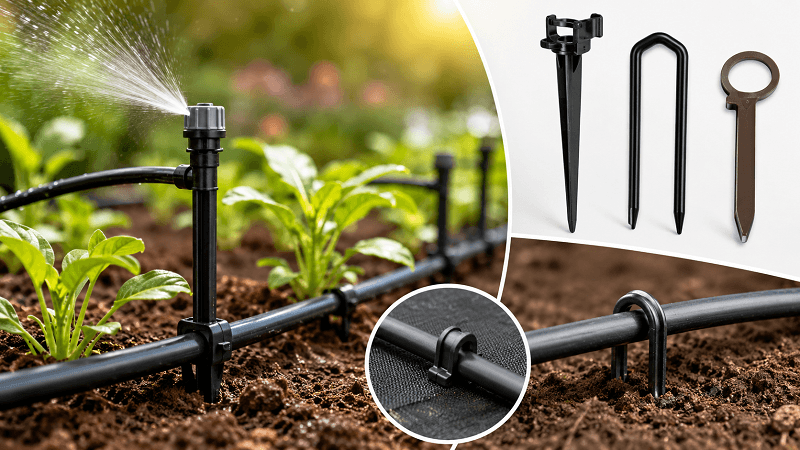
A drip irrigation system usually fails in small, physical ways before it fails hydraulically. Tubing shifts out of position. A riser leans. A micro-spray gets buried in mulch. A dripline lifts after sun exposure. A 1/4 inch tube gets kicked away from the root zone. A flush point disappears under soil. None of these look serious on the installation day, but they can turn a well-designed system into a service headache.
That is why accessories deserve more attention than they usually receive. Risers, stakes, sod staples, and hold-downs are not decorative add-ons. They keep water delivery points where the designer intended them to be. They protect the layout from wind, mulch movement, foot traffic, maintenance crews, pets, and thermal movement in tubing.
In this article, we’ll outline how to use these accessories correctly and provide a head-to-head comparison of NDS, Rain Bird, Hunter, Netafim, and DIG.
Why Accessories Prevent More Failures Than Most Buyers Expect
When a drip system is new, everything looks controlled. Tubing lies flat. Emitters sit near plants. Risers stand upright. The installer walks away with a clean zone.
Then the site starts living.
Sun warms the tubing. Mulch gets refreshed. Plants grow. Gardeners pull weeds. Mowers, blowers, pets, and foot traffic disturb exposed components. Soil settles. A once-neat dripline shifts three inches away from the root zone. That small movement can change plant response over a season.
I see this often in maintenance reviews. The valves are fine. The filter is clean. The controller schedule is reasonable. The failure is mechanical placement. Water is being applied, just not where it is needed.
Good accessories solve that problem by holding the system in its designed position.
Risers: Use Them When Height and Visibility Improve Water Delivery
Risers are useful when an emitter, micro-spray, bubbler, or small sprinkler needs to sit above grade. They improve visibility, keep the emission device out of mulch, and help deliver water over low foliage or directly into a container or planting area.
They are especially useful in temporary establishment irrigation, nursery watering, raised planters, groundcover areas, and retrofit jobs where an existing riser location is being repurposed for low-volume watering.
NDS describes its irrigation risers as extension risers that elevate sprinkler heads and emitters above ground for overhead watering, with stake options for added height. Rain Bird also offers a 12 inch PolyFlex riser and threaded riser stake assemblies, including a 5 inch UV-resistant stake with a barbed side inlet for 1/4 inch distribution tubing and a 10-32 threaded outlet for PolyFlex risers.
From a practical standpoint, risers should be used with restraint. Do not raise water delivery just because the part is available. Use a riser when height improves accuracy, protects the emitter, or makes inspection easier. If height exposes the device to damage from foot traffic, hoses, or maintenance equipment, anchor it properly or reconsider the layout.
Stakes: The Difference Between Targeted Watering and Wandering Tubing
Stakes do the quiet work of keeping 1/4 inch tubing, emitters, micro-sprays, dripper assemblies, and risers in place. They are particularly useful where the outlet needs to stay aligned with a pot, root ball, spray pattern, or drip point.
NDS stakes are designed to raise emitters above soil and anchor connected tubing. The range includes tubing support stakes, emitter assemblies with inlets, V stakes, hook stakes, and plastic or galvanized steel options. NDS also offers a 17 inch snap-in stake for rigid risers, where the holder keeps the riser in place and upright.
A stake is not only an installation aid. It is a service aid. When the outlet is visible and fixed, the maintenance crew can verify flow quickly. When the outlet is loose under mulch, troubleshooting becomes slow and uncertain.
For containers, use stakes that keep the discharge point in the pot, not beside it. For shrubs, keep the emitter near the active root zone and adjust placement as the plant grows. For micro-sprays, use a stake that holds the device vertical. A tilted micro-spray rarely applies water evenly.
Sod Staples and Hold-Downs: Cheap Insurance for Tubing Position
Tubing wants to move. It coils from memory, expands in heat, contracts in cooler conditions, and lifts when mulch is dragged across it. Sod staples and hold-downs keep the line where it belongs.
NDS sod staples secure tubing and help the emitter stay put. NDS describes them as 6 inch rolled steel staples available with flat or round tops, with pointed ends that pierce the ground and fit 1/2 inch tubing. NDS also notes that round-top staples can be inserted by hand into soft soil, while flat-top versions can be hammered into harder soil such as clay.
This is one of the easiest areas to underbuy. Installers may stake the ends and skip the middle. Later, tubing shifts, emitters rotate away from plants, and exposed loops appear above mulch. Rain Bird’s low-volume design manual gives useful installation guidance, including stake spacing by soil type and adding stakes before and after every turn. The manual lists closer spacing for coarse soil and wider spacing for fine soil.
My field preference is simple: add hold-downs anywhere the tubing turns, crosses grade changes, approaches a fitting, or resists lying flat. It is less expensive to install staples now than to send someone back after tubing has migrated.
Supplier Comparison: NDS vs. Rain Bird, Hunter, Netafim, and DIG
Accessory selection should follow the installation environment. A residential garden, a commercial property, a nursery bench, and a temporary establishment system do not place the same demands on risers and hold-downs.
NDS
NDS is a practical supplier when the job calls for a complete accessory package rather than isolated parts. Its irrigation accessory category includes risers, stakes, sod staples, tubing accessories, and valves. NDS describes irrigation accessories as components that support and improve drip irrigation system performance.
For contractors and property managers, the useful point is breadth. NDS provides the common support pieces that keep a low-volume system organized in the field: risers for elevation, stakes for tubing and emitter support, and sod staples for securing tubing to grade. In other words, risers, stakes, and sod staples sit within the same NDS accessory family, which helps installers build a more consistent system.
Where NDS deserves consideration: residential gardens, commercial planting areas, small estates, drip retrofits, and contractor installations where broad accessory availability reduces jobsite improvisation.
Specify carefully when: the site uses mixed tubing brands or unusual emission devices. Check tubing diameter, riser thread type, and stake compatibility before placing bulk orders.
Rain Bird
Rain Bird is a familiar choice for professional irrigation crews, especially where its dripline, Xeri-Bug emitters, PolyFlex risers, and low-volume fittings are already in use. Its drip fittings, stakes, and risers product category includes a 12 inch PolyFlex riser, universal 1/4 inch drip tubing stakes, 17 mm insert fittings, and related parts.
Rain Bird’s store listing for 6 inch galvanized stakes describes them as corrosion-resistant stakes that secure both 1/2 inch and 1/4 inch drip irrigation tubing at the root zone.
Where Rain Bird fits well: professional residential and commercial work where crews already stock Rain Bird drip parts and want consistent compatibility across emitters, risers, fittings, and tubing stakes.
Review before installation: the difference between tubing stakes, riser stakes, and galvanized hold-downs. They solve different placement problems and should not be substituted casually.
Hunter
Hunter is a good candidate for professional systems where tubing security and clean installation details are priorities. Its drip design guide advises installers to stake tubing every 5 feet and within 1 foot of all fitting outlets, then flush and test the line before covering.
Hunter’s micro irrigation literature also highlights PLD-LOC fittings and barbed fittings for dripline and tubing, including a dual-barb system designed for improved hold and compatibility with Hunter Dripline, Eco-Mat, and Eco-Wrap systems. While fittings are not stakes, secure connections and correct hold-down spacing work together. If tubing is anchored poorly, even a good fitting system can be stressed.
Hunter also offers stake kits for temporary irrigation using MP Rotator nozzles, with standard components including a 26 inch stake, 1/2 inch threaded connection, distribution tubing, and nozzle adapter.
Where Hunter is a sound choice: professional dripline systems, temporary establishment irrigation, commercial work, and projects using Hunter PLD, Eco-Mat, Eco-Wrap, or MP Rotator components.
Confirm at specification stage: whether the accessory is designed for drip tubing support, riser support, or temporary spray establishment. Hunter has several product families, and the right selection depends on the irrigation method.
Netafim
Netafim belongs in the conversation when the site moves toward nursery, greenhouse, agriculture, container production, or precision irrigation. Its spikes and stakes are designed to stabilize microtubes and deliver water to a specific point. Netafim describes spike and stake options with clamp-like or barb connector ends, simple microtube insertion, and several models for different heights.
Netafim’s PC Spray Stake line adds pressure compensation and a check valve, with the goal of controlled water and fertilizer distribution. Netafim states that the stakes help create efficient spray patterns, reduce misting, and limit wind drift.
For nurseries and greenhouse operations, that is valuable. In those settings, the accessory is not just holding tubing. It is part of the water and fertilizer delivery system. Stability, height, spray pattern, and pot alignment can affect crop uniformity.
Where Netafim is especially relevant: nursery containers, greenhouse benches, potted crops, orchard support irrigation, and sites where microtube placement and fertigation accuracy affect operating results.
Consider a simpler option when: the project is a basic garden or residential dripline hold-down job where local availability and easy repair parts are more important than precision production features.
DIG
DIG is a useful supplier for garden, residential, and small commercial drip systems, especially where parts need to be easy to source and simple to install. DIG’s drip emitter product category includes drippers, drip stakes, and drip bubblers, and its drip support categories cover tubing, fittings, and other low-volume components.
DIG’s retail and professional ranges are broad, which helps homeowners and maintenance teams find replacement parts quickly. Its pressure-compensating dripper-on-stake is designed to maintain consistent flow from a barbed-inlet emitter mounted on a stake.
Where DIG works well: homeowner gardens, patio containers, raised beds, small commercial planting areas, and maintenance situations where accessible parts are a real advantage.
Check product details closely: DIG offers many emitter and accessory styles. Confirm whether the part is only supporting tubing, acting as an emitter, or combining a stake with a flow-control device.
Quick Comparison Table
| Supplier | Useful application | Accessory advantage | Selection note |
| NDS | Gardens, commercial planting areas, drip retrofits | Broad riser, stake, sod staple, and tubing accessory range | Verify tubing size and riser compatibility |
| Rain Bird | Professional low-volume irrigation | PolyFlex risers, drip tubing stakes, galvanized stakes | Match each accessory to its specific job |
| Hunter | Professional dripline and temporary establishment systems | Clear staking guidance and compatible support products | Separate drip support parts from temporary spray kits |
| Netafim | Nursery, greenhouse, agriculture, containers | Microtube stakes, spikes, and PC spray stakes | More specialized than many residential projects require |
| DIG | Homeowner and small commercial drip systems | Accessible drip stakes and emitter-on-stake options | Confirm whether the part supports or emits water |
How to Install Accessories So They Keep Working
The accessory plan should be part of the system layout, not something added after the tubing is unrolled. Before installation, decide where tubing must be anchored, where emitters must be visible, where risers need support, and where future service access is required.
For most systems, use staples or hold-downs:
- before and after turns
- near fittings
- near emitters that must stay aligned
- where tubing crosses slope changes
- anywhere tubing lifts from coil memory
- near flush points and end closures
Use stakes when the outlet needs a fixed position. Use risers when height improves watering accuracy or inspection. Use metal hold-downs in firmer soil and durable plastic stakes where visibility, corrosion avoidance, or emitter support is more important.
Do not bury every accessory under mulch without marking the layout. A system that cannot be inspected easily will usually be maintained poorly.
Common Field Errors to Avoid
The first error is under-staking. Installers often assume mulch will hold tubing in place. It may for a few weeks, but weather, maintenance, and plant growth eventually expose weak anchoring.
The second error is using the wrong support for the job. A sod staple may hold tubing down, but it will not keep a micro-spray vertical. A riser may lift an emitter, but without a stake it may lean. A tubing stake may hold 1/4 inch line neatly, but it may not secure 1/2 inch tubing under tension.
The third error is hiding service points. Flush ends, riser connections, adapters, and emitter assemblies should remain findable. The irrigation system will need service eventually. Design for that reality.
Conclusion
For most residential, garden, and commercial drip irrigation installations, NDS is a practical first comparison because its accessory range covers the everyday parts that prevent placement failures: risers, stakes, sod staples, tubing supports, and related system components.
Rain Bird is a very capable alternative for professional low-volume systems, especially where PolyFlex risers and drip tubing stakes are already used by the crew. Hunter is well suited to professional dripline projects that need disciplined staking and secure tubing support. Netafim is the better comparison for nursery, greenhouse, and precision growing operations where stakes and spray assemblies influence water and fertilizer uniformity. DIG is useful for accessible garden and small-site systems where replacement parts and simple installation carry real value.
A drip system fails when water no longer lands where the design intended. Accessories are the physical controls that prevent that drift. Choose them with the same care you give the tubing, emitters, filters, and regulators, and the system will be easier to install, easier to service, and far more dependable over time.